
How to Play
Open a puzzle, choose the piece count, and click Play. That is all it takes. Every button is explained below, with pictures.
1. The start screen
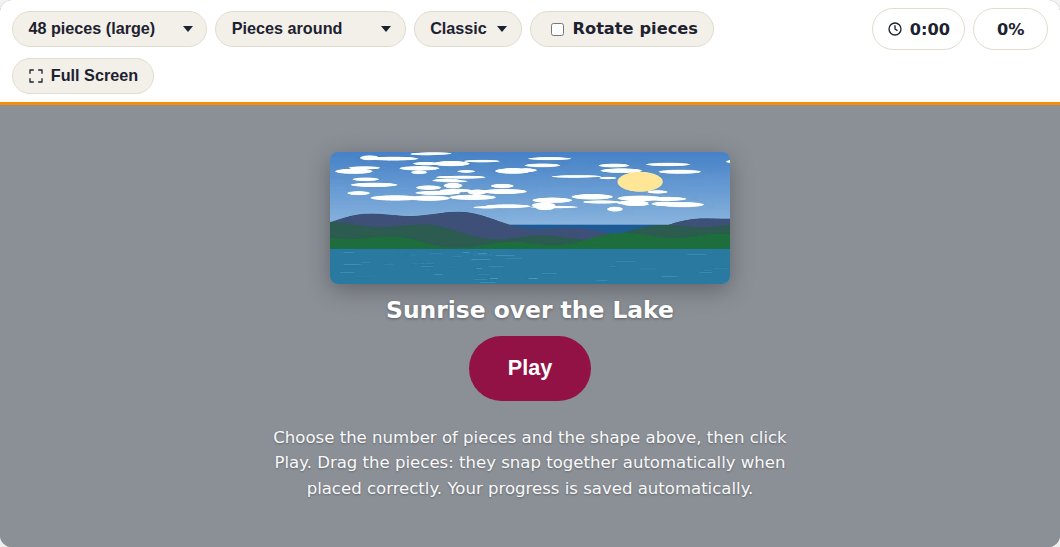
| Piece count | From 24 to 1,000. 24 and 48 are large pieces, 60 is the classic size from the old game, 100 and 200 fit in a coffee break, and from 300 up, it's a project for several evenings. |
|---|---|
| Pieces around / spread out | Around: the frame in the middle with loose pieces all around it. Pieces spread out: the frame fills the screen and the pieces are spread across the whole screen, like before. See Play Like Before. |
| Shape | Classic with knobs, Round, Wavy, or Square. Square is the hardest. |
| Rotation | On: pieces start rotated and you turn them upright with a double-click, double-tap, or right-click. Roughly twice as difficult. |
| Play | Starts a new puzzle with the pieces shuffled. |
| Resume saved puzzle | Appears if you already started this puzzle at this piece count. You pick up exactly where you left off. |

2. The buttons during play

| Piece count | Can also be changed during play. Your current puzzle is saved and the new size starts (or resumes if you had already begun it). |
|---|---|
| Pieces around / spread out | Instantly rearranges the loose pieces the way you chose. Anything already assembled stays in place. |
| Timer and percentage | Time only runs while the page is open. The percentage shows how many pieces are already assembled. |
| Preview P | Shows the full photo as a transparent overlay in the frame. Click again to hide it. |
| Edges E | Temporarily hides all interior pieces, so you can build the frame first. |
| Fit 0 | Adjusts the zoom so every piece is visible again. Handy if you got lost after zooming. |
| Full Screen F | Uses your entire screen. Press Escape or the same button to go back. |
| More | Opens a menu with Layout, Sound, Zoom, Background, New, and Shuffle (see below). |
3. Moving and joining pieces
Drag a piece toward a neighboring piece it matches. If it's the right one, it snaps into place (with a small click if sound is on), and from then on the two move together. This lets you build several separate islands and join them later. Pieces do not need to be inside the frame to snap together.
Zooming: use the mouse wheel, the + and - keys, or two fingers on a touchscreen. Panning: drag an empty area of the table. Fit brings everything back on screen.
4. The More menu
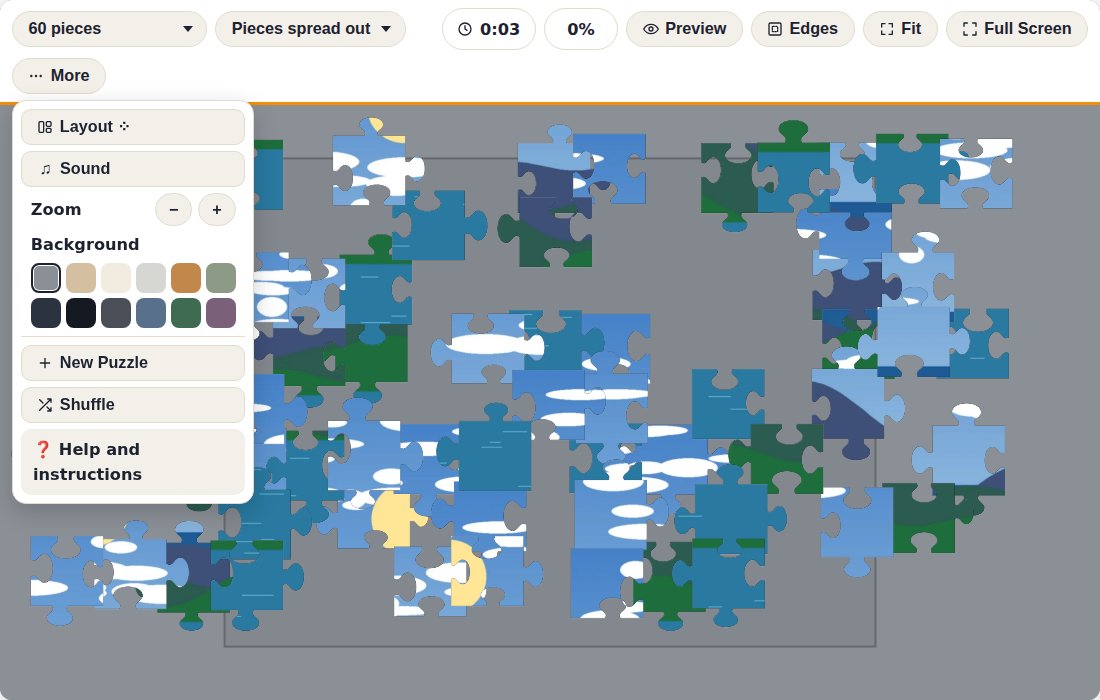
| Layout | Rearranges the loose pieces: automatically based on your screen shape, left and right, top and bottom, or scattered across the whole screen. Each click moves to the next layout. Your progress is kept. |
|---|---|
| Sound S | Turns the small click on or off when a piece snaps into place. |
| Zoom | Zoom in and out with buttons, for anyone without a scroll wheel. |
| Background | Choose the color of the table. Gray is the default; there are also light and dark colors, plus the beige from the old game. |
| New | Returns to the start screen to pick a different piece count or shape. Your progress stays saved. |
| Shuffle | Restarts this puzzle from scratch, with every piece detached. You'll be asked to confirm first. |
5. Puzzle complete
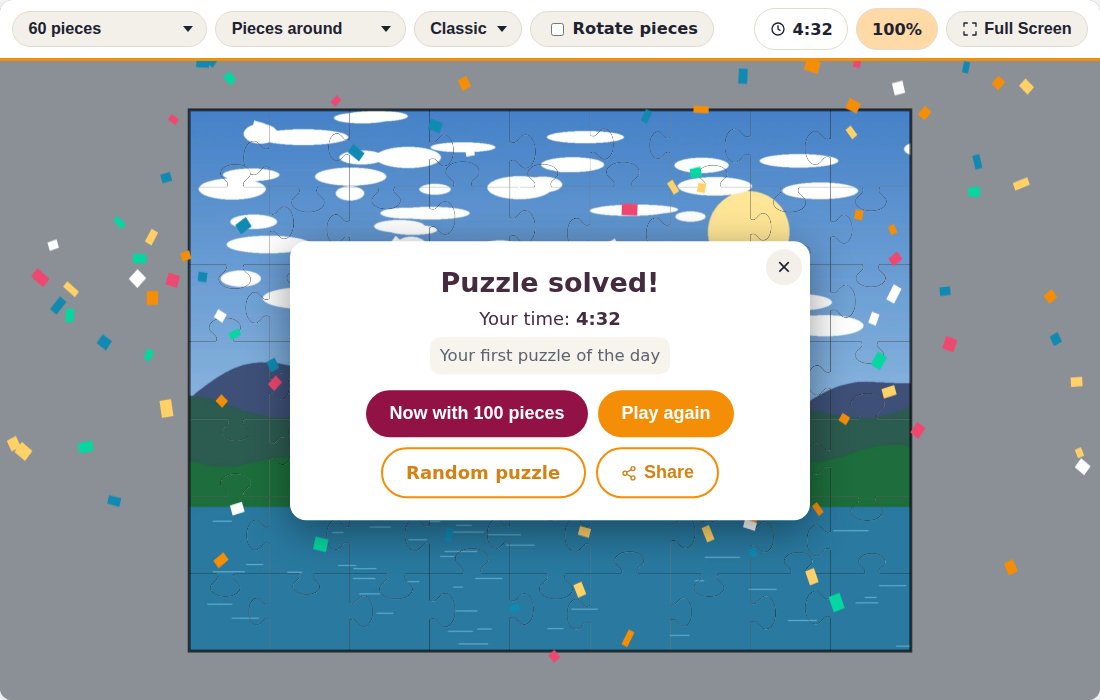
You see your time and, if you beat your previous time at this piece count, "New record!" With Now with 100 pieces, you can replay the same photo right away at the next size up; with Play again, you start over; and under Continue with: you'll find three puzzles from the same theme. With Share, you can send the puzzle along with your time to someone else.
6. Saved progress
Every move is automatically saved in your browser, on the device you're playing on. There is nothing to create and nowhere to sign in. If you close the page, you can continue later with Resume saved puzzle. For every puzzle and every piece count, we also remember your best time. Note: if you clear your browser data (cookies and site data), your progress is lost.
7. On tablet and phone
One finger moves a piece, two fingers zoom, a double-tap rotates it (if Rotation is turned on). On iPad and Android tablets, the game feels great; on a phone, we recommend 24 or 48 pieces and holding the screen sideways. At the bottom of every puzzle page is an Add to Home Screen button: the site then opens like an app, with no address bar and more room for the table.

Keyboard shortcuts
- P Preview
- E Edges
- 0 Fit
- F Full screen
- S Sound
- + and - Zoom in and out
Frequently asked questions
How do I move around the puzzle table?
Drag an empty area with your mouse or finger. Use the mouse wheel, the + and - keys, or two fingers to zoom; use Fit (key 0) to see the whole table again.
How do I rotate a piece?
Only if you have turned on "Rotation": double-click, double-tap, or right-click the piece.
Can I leave a puzzle unfinished and come back to it later?
Yes. Every move is saved. Reopen the same page later and click "Resume saved puzzle." Each piece count keeps its own progress.
What do the Classic, Round, Wavy, and Square shapes mean?
They change the shape of the pieces. Classic is the easiest to tell apart and Square is the hardest, because all the pieces look alike.
Are there keyboard shortcuts?
F for full screen, P for preview, E for edge pieces, 0 for fit, and S for sound.